13 Dumbest Pieces of Advice About Vegan Travel Hacks System Reviews and Complaints 2026 USA — And Why They Keep Wrecking People’s Trips
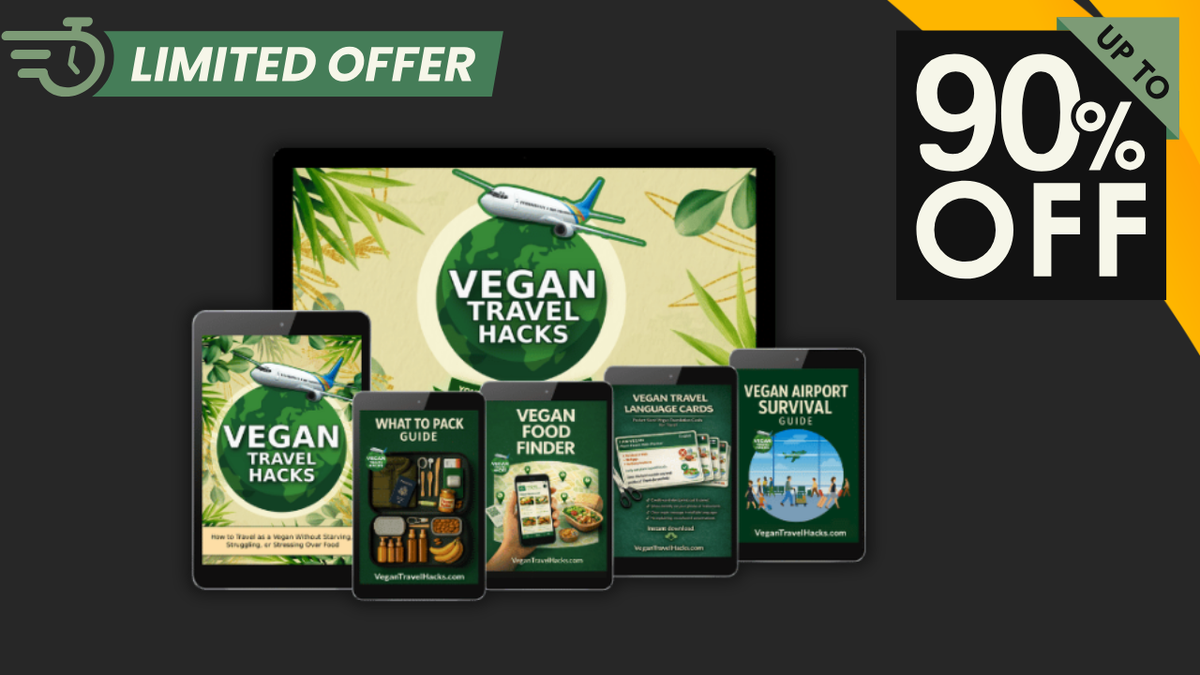
⭐ Ratings: 5/5 ⭐⭐⭐⭐⭐
📝 Reviews: Early buzz is building fast, and the curiosity around this one is very real in the USA
💵 Original Price: $39
💵 Current Deal: $19.95
⏰ Results Begin: Before the trip, not after the airport meltdown
📍 Made In: Digital format, sold through an online launch-style funnel
🧘♀️ Core Focus: Vegan travel planning, backup meal strategy, language help, less food stress
✅ Who It’s For: Vegan and plant-based travelers in the USA, road trippers, airport survivors, overthinkers, people tired of guessing
🔐 Refund: 60 Days. No questions asked.
🟢 Our Say? Highly recommended. No obvious scam energy, no miracle nonsense, just a practical system for a very real travel problem.
Bad advice spreads because it feels good in the mouth. That’s it. It’s candy. Sugary, instant, kind of stupid. It tells people what they want to hear: don’t prepare, don’t think too hard, don’t read the thing, don’t build a backup plan, just vibe your way through the world and somehow the universe will reward you with a fully vegan terminal meal and a smiling waiter who understands every ingredient question on the first try. Sure. And maybe pigeons will start doing customs clearance next.
That’s why so much content around Vegan Travel Hacks system Reviews and Complaints 2026 USA ends up sounding either painfully fake or painfully lazy. One side yells, “This is flawless, life-changing, 100% legit, no scam, I love this product!” The other side smirks and says, “Bro, just Google vegan food near you.” Neither side is especially useful. One is perfume. The other is dust.
And buyers in the USA — smart ones, anyway — are usually searching because they smell that problem. They know they’re being sold something. They just want to know whether the thing solves a real problem or whether it’s another shiny digital product floating around like a motivational balloon.
Fair question.
The honest answer is more interesting than either extreme. Vegan Travel Hacks is built around a pain point that is absolutely real: trying to travel vegan without letting every meal turn into a scavenger hunt, a negotiation, or a side salad funeral. The product is positioned as a digital travel toolkit, not a live concierge app, and it is being sold in the kind of online-digital marketplace environment where launch offers, affiliates, and niche guides are normal. WarriorPlus itself describes its marketplace as a place for digital business owners and online marketers to find and sell online products.
Now add the reality of current USA travel. TSA’s REAL ID rules are already in force, and TSA says travelers without an acceptable ID may have to use its ConfirmID process, including a $45 fee and added time at the airport. That kind of friction matters because every extra delay makes weak food planning more painful, not less.
So yes, the topic matters. And yes, the bad advice around it deserves to be dragged out into daylight.
Let’s do that.
Terrible Advice #1: “Just Google vegan food near you. You don’t need a system.”
This advice refuses to die. It’s like a cockroach in a motivational hoodie.
“Just Google it” sounds sleek because it borrows the glow of technology. It lets people feel modern without being prepared. They get to act like planning is for anxious amateurs, while they themselves are some kind of free-range genius wandering through the USA armed only with a search bar and confidence. Beautiful image. Terrible plan.
Google Maps is useful. Search is useful. Obviously. Nobody serious is arguing otherwise. But useful is not the same thing as dependable under pressure, and pressure is exactly what travel creates. Especially food pressure. Especially vegan food pressure. Especially in the USA, where one airport terminal can look like the future and the next one looks like 2006 got trapped in a pretzel warmer.
Here’s where the advice breaks: a last-minute search depends on too many delicate little threads all staying intact at the same time. Battery. Signal. Updated listings. Accurate labels. Time to scroll. Brain functioning normally. Staff actually knowing what vegan means. The restaurant actually being open. The food actually being more than fries with emotional trauma on the side.
That is not a system. That is roulette with Wi-Fi.
And once you follow that advice long enough, travel starts to feel like paperwork. Every meal becomes research. Every stop becomes a mini project. You spend more time scanning, rejecting, checking, re-checking, and settling than actually enjoying anything. It’s not dramatic failure, which almost makes it worse. It’s repetitive low-grade friction, the kind that rubs the shine off a trip inch by inch.
What actually works is less glamorous and far more effective: use search tools as part of a broader setup. A decent system means you already know likely weak spots before you get there. You’ve got saved notes, maybe a card, maybe a backup snack, maybe a shortlist. You are not outsourcing your survival to one search result and a prayer.
That, by the way, is one reason the Vegan Travel Hacks system has some real logic behind it. It is not saying “never use apps.” It is saying, more or less, stop acting like apps are enough. That distinction matters. A lot.
And yes, it matters in the USA too. The lazy myth is that vegan food is now everywhere in America, so all this planning is overkill. But travel businesses themselves are still being told that catering better to vegan guests is a growth opportunity, which tells you the market is growing — and still uneven enough that there’s money in doing better. Booking.com’s partner guidance literally frames vegan accommodation and food support as a way to attract more bookings and improve guest satisfaction.
So no, “just Google it” is not some enlightened shortcut. It’s a patch. Sometimes patches help. Sometimes they peel off in the rain.
Terrible Advice #2: “If the menu says vegetarian, that’s basically safe.”
This one is deeply, magnificently dumb.
It survives because people adore fuzzy categories when those categories save them effort. “Vegetarian” feels close enough to “vegan” for people who aren’t the ones dealing with the consequences. It’s tidy. It’s soothing. It’s wrong.
Vegetarian is not vegan. That is not a semantic footnote. That is the whole thing.
Yet the internet keeps producing this advice as if cheese, butter, cream, yogurt, egg, mayo, hidden dairy, sneaky sauces, and all the other familiar little saboteurs don’t exist. As if menus never lie through omission. As if kitchens never improvise. As if servers never misunderstand.
Please.
The problem gets sharper when people travel outside the USA, sure, but it absolutely exists inside the USA too. Plenty of restaurants still use broad labels casually. “Vegetarian option” can mean “remove the meat and keep everything else.” In some places, “plant-based” is used like a costume. In others, the staff means well but doesn’t know enough to answer clearly. Intentions are lovely. Intentions do not remove butter.
And this is where lazy advice becomes expensive. Maybe not financially expensive — though even that can happen — but expensive in energy, comfort, mood. You end up scanning ingredients harder than you should have to. Then you start asking follow-ups after the meal arrives. Then you feel awkward. Then the whole table gets tense. Then you either eat uneasily or send something back. It’s all avoidable, and yet people keep acting like “vegetarian” is some magical safe zone.
It isn’t. It’s a suggestion. Sometimes a trap dressed as a suggestion.
What actually works? Precision. Specific questions. Clear communication. Less guessing.
This is one of the more believable strengths of the Vegan Travel Hacks system, honestly. The language-card angle sounds almost too simple at first, and that’s exactly why some people underestimate it. But simple tools are often what survive real life. If you can show a clear, polite statement of what you do and do not eat — especially when you’re tired or in a rush or dealing with a language gap — that can save a surprising amount of nonsense.
A flashlight is not glamorous either. Still useful when the lights go out.
Terrible Advice #3: “If the product is really legit, it should work without any effort from you.”
This is buyer fantasy at its most shameless.
The logic goes like this: if a product is highly recommended, reliable, 100% legit, then it should basically solve the problem while you contribute almost nothing except the payment. You shouldn’t have to read much. You shouldn’t have to plan anything. You shouldn’t have to save files, use the modules, think ahead, or — heaven forbid — prepare.
This is nonsense. Charming nonsense, maybe, because everyone likes the idea of magical convenience. But nonsense.
A toolkit is not a teleportation spell.
If Vegan Travel Hacks were pretending to be some live, AI-powered, always-updated restaurant-routing engine for the whole world, then maybe you could judge it on that fantasy. But that’s not what it claims to be. It is a digital system. A structure. A set of resources intended to reduce chaos before and during travel. That means it does better when you engage with it like a person with agency, not like a decorative rock waiting to be rescued.
This is the same problem people have with planners, cookbooks, courses, workout apps, language programs, pretty much everything. They resent the existence of participation. They want the purchase to be the transformation. They want the receipt to count as the result.
That is not how reality works. It’s definitely not how travel works.
Follow this bad advice and what happens? People buy the product, skim it badly, ignore the useful bits, don’t prepare for their weak travel points, and later complain that it wasn’t “enough.” Enough for what? To compensate for you doing nothing? That’s not a fair test. That’s a toddler test.
What actually works is the boring thing people love to mock and secretly benefit from: preparation. Tiny preparation, not military logistics. Save the key resources. Use the cards. Think about arrival-day food. Pack a fallback snack. Decide where your trip is likely to get stupid before it gets stupid.
That’s why systems beat hope.
Hope is lovely, and I support it in many contexts. But hope is not a meal plan.
Terrible Advice #4: “You’re in the USA. Vegan travel is easy now, so this is overkill.”
This advice is aggressively bubble-brained.
It comes from people who live in food-comfortable little pockets of the USA and assume the whole country behaves like their neighborhood. They’re two blocks from vegan tacos, a bakery with oat milk frosting, and a place doing mushroom shawarma until midnight, so naturally they decide the entire American travel map has been solved.
No. Not even close.
The USA is huge, uneven, and full of tiny logistical betrayals. One region makes vegan travel feel easy. Another region makes you feel like you’re asking for moon dust. Airports vary wildly. Road-trip routes vary wildly. Hotel districts can be awful. Conference zones are often useless. Tourist areas can be weirdly shallow and overpriced. Small towns? Coin toss.
So yes, vegan food availability in the USA has improved. That part is real. But improved is not the same as frictionless. And friction is the whole issue.
This is also where current travel realities matter. TSA’s identity rules and ConfirmID fallback process show how even ordinary domestic travel in the USA can still become slower and more irritating than people expect. When delays stack up, food planning matters more. Not less.
Believe the “America has options everywhere now” line and you’ll underprepare. You’ll assume the trip will carry you. Then you get a late arrival, a dead hotel neighborhood, a road stop with nothing useful, or a terminal where the “healthy choice” is a cup of grapes and a lecture. Suddenly the country doesn’t feel so solved.
What actually works is simple: treat USA travel like travel. Not like an extension of your kitchen, not like your hometown in a costume. If you know your weak spots — airports, hotel check-ins, long drives, group dinners, weird schedules — you can plan around them. That is exactly the kind of logic a product like Vegan Travel Hacks is trying to package.
And honestly, that’s reasonable. Not sexy, but reasonable. Most successful travel habits are like that. They look boring until they save your mood.
Terrible Advice #5: “You don’t need backup snacks or fallback meals. Just be flexible.”
I hate this advice on a personal, almost spiritual level.
“Just be flexible” is one of those smug lines people use when they have never been truly hungry in the wrong place at the wrong time. Or they have, and somehow their brain turned that into philosophy instead of learning.
Flexibility is great. Love flexibility. Flexibility is easier, though, when your blood sugar is not staging a coup.
Travel breaks down in tiny ways. That’s what makes this so predictable. Delays. Closed restaurants. No kitchen access. Late check-in. Road-stop disappointment. Group plans changing. The one promising place being shut for some random reason. One thing, then another, then another. Nothing cinematic. Just friction stacking like wet clothes.
Backup food is not paranoia. It’s cushioning. It’s the little strip of rubber between you and the metal.
Ignore that and what happens? The day gets mean. Not objectively catastrophic, maybe. Just mean. You start settling for junk because you have to. Or you keep searching too long because nothing feels adequate. Your energy dips. Your patience narrows. And suddenly a manageable situation feels gigantic, which is one of travel’s favorite tricks.
What actually works is so embarrassingly simple it almost feels rude: pack something. Have fallback options. Know how to build a real emergency meal from ordinary store items. Think about arrival-day survival instead of acting like every trip begins with perfect timing and a fully stocked vegan café downstairs from your hotel.
That’s one of the stronger ideas in the Vegan Travel Hacks system. It seems to understand that the weak moments matter as much as the ideal ones. Maybe more. Anybody can enjoy a great meal when the great meal is obvious. The real test is what happens when it isn’t.
And I’m sorry, but the crunch of a backup snack when everything else went sideways? Sometimes that’s the sound of civilization.
Terrible Advice #6: “All those ‘I love this product’ and ‘no scam’ phrases basically prove it.”
No. They don’t.
They signal. They hint. They decorate. They sell emotion. They are not proof.
People search with phrases like:
- i love this product
- highly recommended
- reliable
- no scam
- 100% legit
That’s normal buyer behavior. They’re looking for reassurance. But reassurance language is cheap. It takes almost no effort to type “highly recommended.” It takes a bit more effort to explain why something is useful, for whom, in what situations, and where its limits actually are.
The smartest way to evaluate a product like Vegan Travel Hacks is not to get hypnotized by praise language. It’s to ask uglier, better questions:
Does this solve a real problem?
Is the mechanism believable?
Does the price make sense for the pain point?
Will the intended buyer actually use it?
Is the offer matched to real travel situations, or is it mostly theater?
Those questions are better. Less romantic. More useful.
In this case, the pain point is real enough that hospitality businesses themselves are being advised to adapt to vegan travel demand. Again, that does not prove this specific product is perfect. It does prove the problem category is not imaginary.
What actually works is alignment, not adjectives. If you travel often, hate guesswork, and want a low-drama system you can reuse, the product may fit. If you expect a constantly updated live app that does the thinking for you, then no amount of “100% legit” wording will magically turn a toolkit into that.
Simple.
Terrible Advice #7: “Experienced travelers don’t need a guide like this.”
This one sounds sophisticated, which is why it sneaks past people.
The idea is that once you’ve traveled enough, you’ve “figured it out.” So anything structured — a guide, a checklist, a system — must be for beginners or nervous people.
That’s cute. Also false.
Experience does not automatically mean efficiency. Plenty of experienced travelers are just repeatedly surviving the same avoidable nonsense with slightly more confidence. They’ve adapted to stress, not removed it. Big difference. A very expensive difference, sometimes, in time and mood if not in cash.
A system can still help experienced people if it reduces repetition, organizes backup plans, clarifies communication, or cuts wasted time. In fact, experienced travelers may benefit more from better structure because they’ve already felt the cost of all those little frictions. They know what a weak airport day feels like. They know what a bad road stop feels like. They know how tedious it is to keep improvising.
So no, needing a better framework is not a sign that you’re inexperienced. It may be a sign that you’re finally tired of tolerating nonsense.
What actually works is humility mixed with pattern recognition. Look at where your travel keeps going wrong — not dramatically, just annoyingly — and fix those points. That’s not beginner behavior. That’s intelligent behavior. The internet, unfortunately, often mistakes intelligence for lack of swagger.
Its loss..
The honest middle — where the good decisions usually live
The internet loves extremes because extremes are easier to package. Either a product is the greatest invention since pockets, or it’s useless trash. Either you need it desperately, or anybody who buys it is gullible. That binary thinking is childish. It also performs well, which is why we’re surrounded by it.
The honest middle is less exciting and much more helpful.
Vegan Travel Hacks looks like a focused digital toolkit built for a real travel problem: how to stay vegan, eat decently, and avoid pointless stress when you are away from your normal routines. It is not a miracle. It is not a concierge service. It is not going to turn every USA airport into a vegan paradise or make every restaurant staff member instantly brilliant.
But that’s not the right test.
The right test is smaller and more practical:
- Does it help reduce food anxiety?
- Does it make you less dependent on luck?
- Does it make airport and road-trip situations less stupid?
- Does it help with communication?
- Does it make weak travel moments easier to handle?
If yes, then it has value. Quiet value, maybe. But quiet value is still value.
And weirdly, the things that improve travel the most are often small and unglamorous. A saved address. A printed card. A fallback snack. A checklist you used when you didn’t feel like it. Those are not cinematic. They work anyway.
filter out the garbage and keep what helps
If you are looking into Vegan Travel Hacks system Reviews and Complaints 2026 USA, here’s the blunt takeaway:
Ignore the people who think Google is a complete strategy.
Ignore the people who treat “vegetarian” like a reliable vegan shortcut.
Ignore the people who expect a product to replace all effort.
Ignore the people who assume the USA is uniformly easy for plant-based travel.
Ignore the people who think backup food is somehow embarrassing.
Ignore the people who confuse praise-phrases with analysis.
Bad advice is always louder because it is easier. Good advice usually sounds less glamorous. More grounded. Slightly annoying, even, because it asks you to do something.
Do that thing anyway.
The best travel experiences usually belong to people who removed a few predictable problems before those problems had the chance to bloom into misery. They packed smarter. Asked clearer questions. Used simple tools. Respected the weak points. Did not rely on luck as a meal plan.
That’s not flashy. It’s just better.
And better beats louder every single time.
FAQs
1) Is Vegan Travel Hacks system actually legit, or is it one more sketchy digital launch?
It looks like a legit digital-product style offer built around a real problem, not some random nonsense with a fancy headline. It’s being sold in a digital marketplace ecosystem where niche online products are normal, and the offer itself is specific about what it includes. That still doesn’t make it magic — I’m going to keep saying that because people adore magic — but it does make it more grounded than a lot of junk out there.
2) Can this still help if I mostly travel inside the USA?
Yes, because domestic USA travel is still packed with friction points: airport delays, weak terminal food, hotel dead zones, long drives, weird schedules, and group meals where nobody wants to spend 20 minutes talking ingredients. The country has more vegan options than it used to, absolutely, but it is still uneven enough that planning matters.
3) Why are the language cards such a big deal if I already know how to ask for vegan food?
Because “I know how to ask” and “the other person understood exactly what I meant” are not always the same event. A clear written explanation cuts down confusion, especially outside the USA, but even sometimes inside it. It’s a humble tool. Humble tools save trips all the time.
4) Do I really need backup snacks, or am I being dramatic?
You need them. Not a whole bunker. Just enough. Travel creates stupid little breakdowns constantly, and one decent backup option can stop a rough day from getting rougher. This is one of those areas where a tiny bit of preparation pays back way more than it costs.
5) Is this better than just using Google and food apps?
It’s better as a layer, not as a replacement for common sense. Google and apps are reactive. A system like Vegan Travel Hacks is more proactive. The smartest approach is usually both: search tools plus planning, not search tools instead of planning. Because when the trip gets messy — and trips do — layers beat hope.
Related Hastags
#VeganTravelHacks #VeganTravelHacksReview #VeganTravelHacksReviews2026 #VeganTravelHacksAppReview2026 #VeganTravelHacksBonus #VeganTravelHacksProduct #VeganTravelHacksPrice #VeganTravelHacksOffers #VeganTravelHacksBonuses #VeganTravelHacksBuy #VeganTravelHacksWebsite #VeganTravelHacksSite #VeganTravelHacksApp #VeganTravelHacksHonestReviews #VeganTravelHacksLatestReviews #VeganTravelHacksUsersExperience #VeganTravelHacksUsersReview #VeganTravelHacksDemo #VeganTravelHacksTutorial #VeganTravelHacksPurchaseOnline #VeganTravelHacksBuyit